
At Pieter Claesz’s Table
Part of the enduring appeal of Dutch still lifes is how they compel us to look anew at the familiar — the gleam of silver, light caught in a glass, the curling peel of a lemon suddenly become worthy of our attention. But, as with so much seventeenth-century Dutch painting, what we see is only part of the story. These seemingly simple arrangements can be filled with clues — to wealth and trade, pleasure and morality, and the inevitable passage of time.
Opening this November at the Kunst Museum Winterthur in Switzerland, At Pieter Claesz’s Table is a tightly focused, one-room exhibition bringing together three works by one of the great innovators of Dutch still-life painting. Organized in cooperation with the Kaiserschild Foundation, the Kunsthistorisches Museum in Vienna and the Alte Galerie of the Universalmuseum Joanneum in Graz, the exhibition offers a closer look at Claesz’s masterful still lifes and the world encoded within them.
Working in Haarlem during the first half of the seventeenth century, Claesz helped usher in a new kind of still life. His monochrome banketjes, or monochrome banquet pieces, traded the colorful abundance of earlier compositions for a more restrained palette and seemingly casual arrangements of food and tableware. What appeared effortless was, of course, anything but.
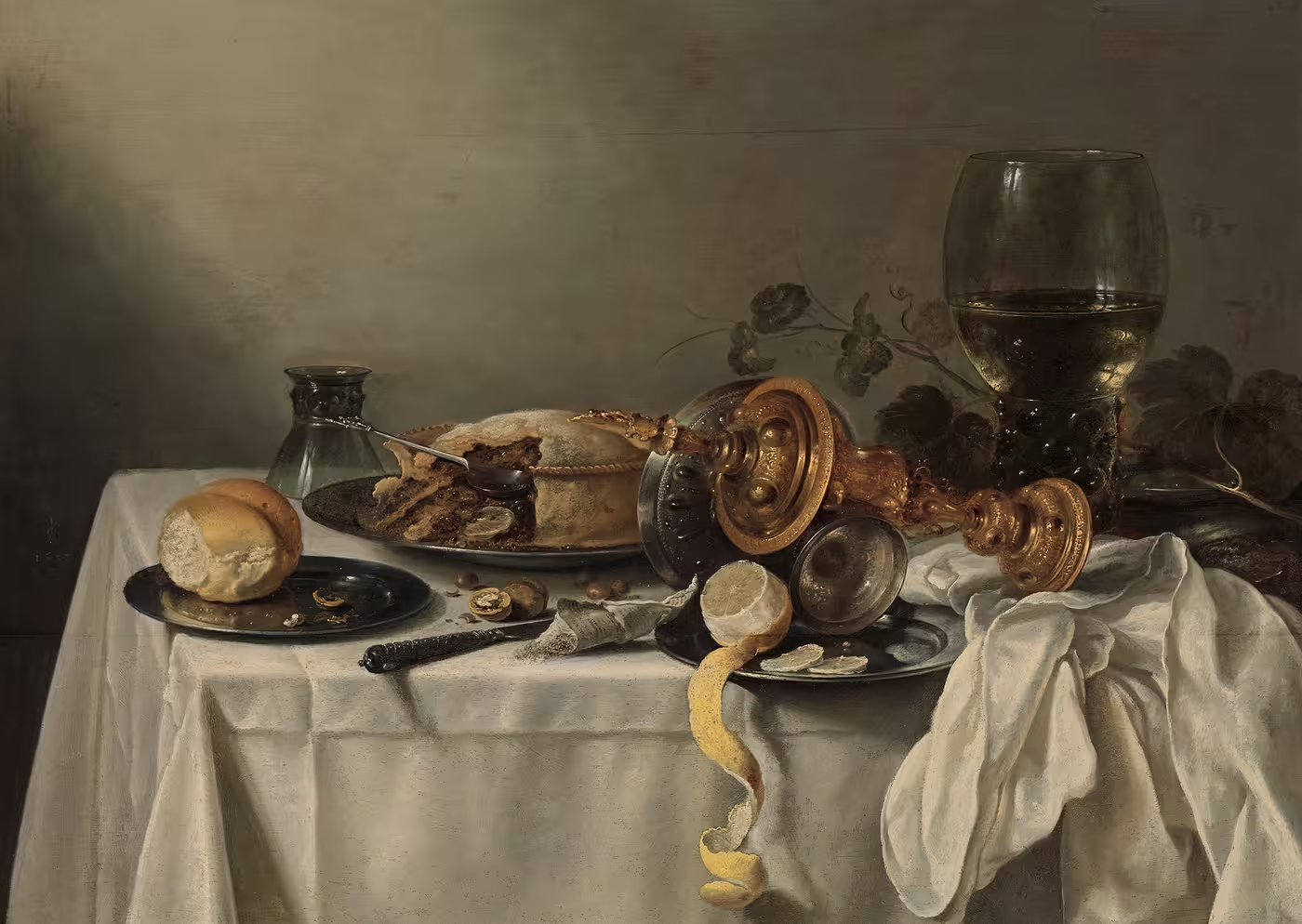
The exhibition brings together three paintings that reveal just how much could be communicated through the objects on a table. In the museum’s own Still Life with Fruit Pie, Silver Tazza, Gilt Covered Cup and Roemer of 1637, an opulent spread of expensive foods and precious vessels reflects the remarkable prosperity of the Dutch Republic and its increasingly affluent bourgeoisie.
And a seventeenth-century viewer would have known how to read the table. The silver tazza, gilded covered cup and roemer were not simply beautiful props but recognizable status symbols, their materials, workmanship and origins conveying wealth and taste. Claesz rendered each with such precision that even the distinction between silver, glass, pewter and linen becomes part of the pleasure of looking.

The mood changes dramatically in Still Life with Glass Goblet of 1642. Gone are the lavish vessels and elaborate feast. In their place is a simple Dutch meal of herring, onions, bread and beer, painted in Claesz’s characteristically muted greys and ochres. Yet even this modest meal may hold another layer of meaning: the bread and wine have been interpreted as references to the Last Supper, while the fish evokes the dietary observances of Lent. In the Protestant Netherlands, such associations would have been readily understood.
Then there is Claesz’s extraordinary ability to make these carefully constructed scenes appear entirely spontaneous. A rumpled cloth slips over the edge of the table; bread is broken, food half eaten, glasses seemingly left where someone last set them down. Elsewhere in his work, the artifice becomes even more apparent — in one painting, for example, fresh strawberries appear alongside autumn leaves, a seasonal impossibility and a reminder that these convincing scenes were assembled rather than simply recorded from life.
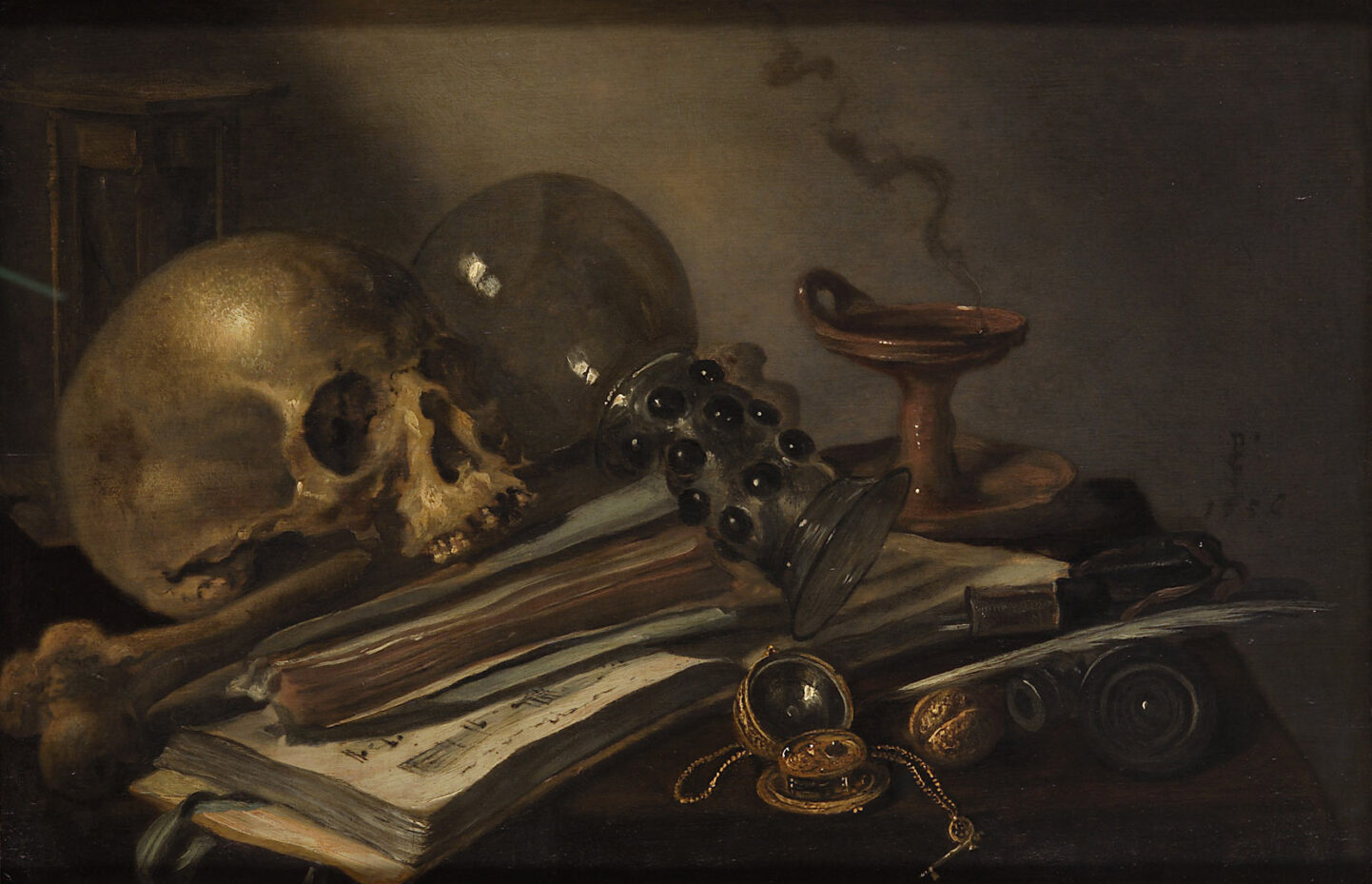
The final painting, Vanitas Still Life of 1656, strips away any ambiguity about the message. A skull, fallen roemer and watch turn the pleasures and possessions of the earlier tables on their head. The watch marks the relentless passage of time, the overturned glass suggests pleasures brought to an end and the skull delivers the ultimate memento mori: remember that you must die.
Seen together, the three paintings move from abundance to austerity and finally mortality — a reminder that in the hands of Pieter Claesz, setting the table was never simply about what was for dinner.
At Pieter Claesz’s Table: Focus on Still Life
Kunst Museum Winterthur, Reinhart am Stadtgarten
November 14, 2026 – March 14, 2027
