

The Met x Sabyasachi: A Conversation Across Cultures
Every so often a collaboration is announced that makes so much sense you might wonder why it took this long. The Metropolitan Museum of Art and Sabyasachi—the Kolkata-based house founded by Sabyasachi Mukherjee in 1999 and now one of India’s most recognized luxury houses—announced today a multi-year partnership, with the first chapter arriving this September during New York Fashion Week: a High Jewellery collection inspired by Byzantium. Among the first pieces revealed is this pendant necklace in 18- and 22-karat gold set with tourmaline, garnet, jasper, lapis lazuli and jade, inspired by a 2nd–3rd century CE Roman marble funerary relief in The Met collection.

And here, the remarkable source of its inspiration:

The Metropolitan Museum of Art, New York, Fletcher Fund, 1949
The pieces were all there already, if you’d been paying attention. Sabyasachi has spent twenty-five years approaching craft with the rigor of scholarship, drawing deeply on India’s extraordinary traditions while continually finding new ways to interpret them. He dressed Alia Bhatt for the Met Gala in 2024 and Shah Rukh Khan for his debut there in 2025, so the museum and the house were already circling each other on the red carpet. And the subject of this first collection, Byzantium, is itself a story of cultures meeting through trade—which happens to be exactly the terrain Sabyasachi works in every day. None of that guaranteed a partnership like this one, but it does explain why it doesn’t feel like a stretch.
Byzantium is an intriguing place to begin. At the crossroads of continents, the empire absorbed influences from Ancient Egypt, Greece, Rome and Persia, extending east along the Silk Route via India. The resulting mix of cultures, materials and techniques is central to this collaboration—and helps explain why Sabyasachi has looked well beyond The Met’s Byzantine galleries. His sources range across the museum’s Greek and Roman, Medieval and Islamic collections. That range is evident in a pair of extraordinary gold cuffs, each inspired by a Roman sarcophagus. One, set with garnet cabochons and brown diamonds, draws on a third-century marble sarcophagus depicting lions felling an antelope; the other, set with garnet and tourmaline, takes its inspiration from The Triumph of Dionysos and the Seasons, dating to around 260–270 CE.

What I like about this collaboration isn’t just the pieces, though—it’s who’s doing the interpreting. The Met itself describes the objects, motifs and techniques in its collection as “departure points” for Sabyasachi. Stephen Mannello, The Met’s Head of Retail and Global Licensing, put it this way in today’s announcement: “Engaging with Sabyasachi and his team allows us to view works from antiquity through a new lens.”
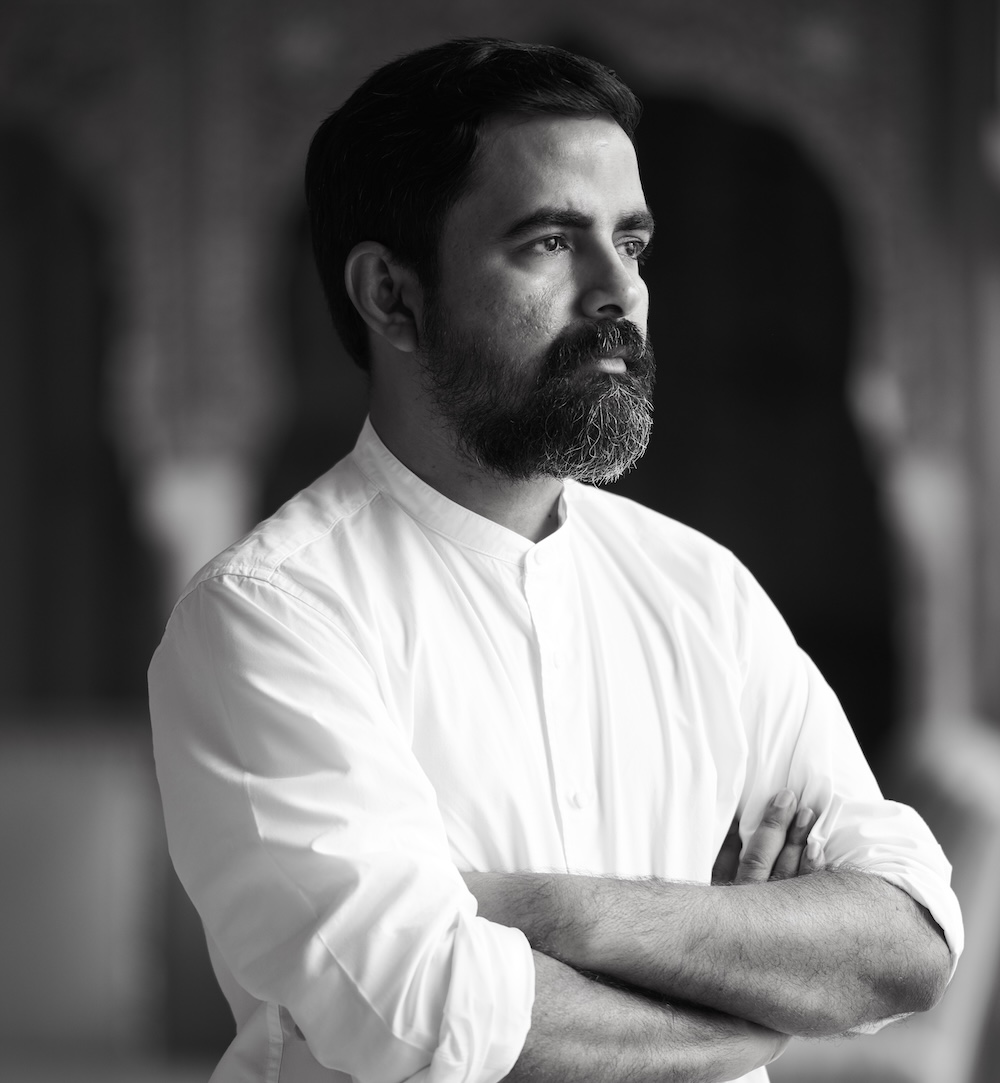
Sabyasachi Mukherjee himself framed it in more personal terms: “The Byzantine world was not defined by a single geography. It was shaped by the movement of people, ideas, and craftsmanship across continents including India… I find similarities to my home, Calcutta, itself a commercial hub influenced by trade and exchange.”
The pieces revealed so far show just how broadly he has interpreted that brief: the extraordinary cuffs take their inspiration from Roman sarcophagi; a jewel-encrusted pendant looks to a Roman funerary relief; while the wonderfully unexpected tiger-claw necklace, below, derives from a 12th-century Italian or Byzantine carved panel depicting animals.

Source Object: Casket with Erotes and Animals, Italian or Byzantine. Gift of J. Pierpont Morgan, 1917 12th century.
Perhaps the most telling example is the pair of earrings, above, inspired by a 17th-century Islamic zodiac coin from Agra, India. The coin was part of an extraordinary series conceived by the Mughal emperor Jahangir, who replaced the customary written month on his coins with the corresponding sign of the zodiac—Capricorn in this case. That an Indian source should find its way into a collection inspired by Byzantium is precisely Sabyasachi’s point: the story is not about one empire in isolation, but about the cultures connected through centuries of trade and exchange.

The references continue across both geography and time. This pendant necklace in 18- and 22-karat gold, jasper, onyx and jade takes its inspiration from an 11th-century German book-cover plaque, borrowing the lion—the symbol of Saint Mark—from its depiction of the Four Evangelists.


As Sabyasachi perhaps summed it up best: “History does not exist in fragments. It exists in a continuum.”
And perhaps that is also why jewelry remains so fascinating to me. At its best, it concentrates an astonishing amount of information into a very small object—material, technique, commerce, culture, status, taste and, of course, beauty. A jewel can be intensely personal and simultaneously a reflection of its time.
The most successful museum collaborations do something similar. They don’t merely reproduce masterpieces; they encourage us to look again at the originals and, ideally, to see something we hadn’t noticed before.
Come September, we’ll see where that conversation leads.
