
If You Missed It: Painters, Ports, and Profits at the Yale Center for British Art
There are exhibitions that come and go quietly, and then there are the ones you wish you’d made the trip to see with your own eyes. Painters, Ports, and Profits: Artists and the East India Company, 1750–1850, which closed this week at the Yale Center for British Art, falls firmly into the latter category. I’m including it here anyway, because the catalogue endures, the questions it raised are worth sitting with, and frankly, I’d rather you know it existed than let it slip by unmentioned.
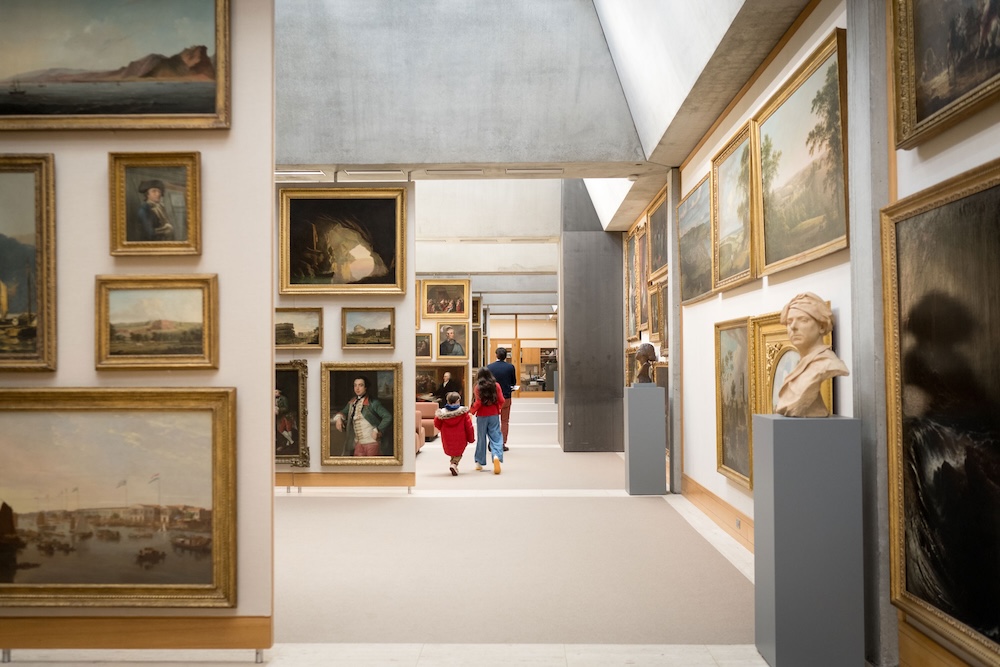
A quick word on the museum itself for those who haven’t made the trip to New Haven: in 1966, Paul Mellon gave the building, works of art, and endowment that established the Yale Center for British Art, and tellingly, he insisted it not carry his name. It holds the largest collection of British art outside the UK, housed in a quietly masterful Louis Kahn building on the Yale campus. Mellon married Bunny Lambert Lloyd in 1948 — the eminent horticulturalist, gardener, art collector and dare I say tastemaker whose own eye for beauty needs no introduction in these parts — and between the two of them, their influence on American taste, collecting, and philanthropy was legendary. The museum itself is free, it is rarely crowded, and it rewards the kind of unhurried looking that’s increasingly hard to come by.

This particular show set out to do something genuinely new. Rather than treating Indian, Chinese, and British artists of the period as separate, parallel histories, curators Laurel O. Peterson and Holly Shaffer (who teaches at Brown, my own alma mater, where I studied art history) built the exhibition around the idea that their practices were deeply, productively entangled — shaped together by the reach of one of history’s most powerful and ruthless commercial enterprises: the British East India Company. As the Company’s trade routes carried silk, tea, and opium across oceans, they carried something else too: papers, pigments, techniques, passing between artists who’d likely never have crossed paths otherwise. What came out of that exchange wasn’t any single style — it was something hybrid, unpredictable, born of commerce as much as creativity.

Among the highlights were two striking portraits: Tilly Kettle’s monumental Woman Holding a Hookah at Faizabad, India, from 1772, above, and a far more intimate, unsigned Portrait of a Woman from around 1850, attributed to the circle of the painter Lam Qua. There were botanical and natural history studies of real precision too — a great Indian fruit bat, a breadnut split open to reveal its interior, at top, and a 1790 drawing of a rhinoceros by Gangaram Chintaman Tambat, the most extensively featured artist in the show, with upward of twenty works on display. Even these quieter studies of flora and fauna, the exhibition made clear, were often tangled up in questions of profit and empire.

But the piece I keep coming back to is Lucknow from the Gomti — a sweeping scroll, just over thirty-seven feet long, below, made sometime between 1821 and 1826, that made its public debut in this show. Nobody signed it, and current thinking is that more than one artist contributed to it. What survives is an unfolding view of the city along the Gomti River — palaces, riverside structures, boats, daily life — painted with the kind of precision meant to satisfy a patron back in Europe who would likely never see the place for himself. The conservation alone is its own story: after two years of careful work to address how the paper had warped and resisted lying flat over two centuries, the museum ultimately showed only half the scroll at a time, unrolling it in stages — which meant, in effect, two exhibitions in sequence within a single gallery.

It’s a reminder of something I find myself circling back to again and again here in Q Tips: the most extraordinary objects often have the most complicated histories, and the two are often inseparable. This scroll, like so much of what was on view, exists because of a system of trade and control most of us would now find indefensible — and yet it is also, simply, a stunning piece of craftsmanship, made by artists whose names we may never know.

The accompanying book, above, published by the Yale Center for British Art and distributed by Yale University Press, is very much worth seeking out even with the show now closed. It gathers essays from an international roster of scholars and conservators and goes considerably deeper into the individual stories — of artists, materials, and the routes objects traveled — than any single visit could.

Thanks so much for noting this wonderful exhibit! I love this museum and visit as often as I can – and this was my favorite exhibit since the exhibit featuring animal portraits owned by Queen Elizabeth II, which was in the 1980s. So much to learn, so much to see, never enough time!
Agreed! And the Mary Delaney exhibit was great as well.
Thank you. I’m definitely going to search out the book as I sell quite a bit of antique Asian Art and chinoiserie. I, too, have questioned the East India Company.
Best, Mary
It looks like a good addition.
My husband,son and I were one of the last visitors before the building closed for renovations 2 years ago
I love this museum and really wish I had seen this exhibit